Structural Drying & Dehumidification in Columbia, SC
Extraction removes the water you can see. Structural drying removes the water you can’t – the gallons soaked into drywall, framing, subfloors, and concrete that cause mold, rot, and structural damage if left behind. Columbia Flood Fix Pros connects you with independent local providers who run professional structural drying across Columbia, SC, verified with daily moisture readings. (803) 555-0147
Why Drying Is a Science, Not Fans
Proper structural drying follows the IICRC S500 standard: establish a drying chamber, place commercial air movers to create airflow across wet surfaces, run refrigerant or desiccant dehumidifiers sized to the cubic footage and saturation level, and take daily moisture readings until every material returns to its dry standard. Too little equipment and materials stay wet; too much heat without dehumidification and you bake moisture deeper in.
Columbia's Humidity Problem
The Midlands runs humid most of the year – summer relative humidity routinely sits above 70%. That ambient moisture fights every drying job: open a window and you’re importing wet air. Professional drying means sealed chambers and dehumidifiers pulling gallons of water from the air daily, not box fans fighting the South Carolina summer.
What Providers Dry
Hardwood floors (with specialized floor-drying mats), drywall and plaster, wall cavities, subfloors, concrete slabs, crawl spaces, attics, and commercial structures. Each material has a different dry standard – wood framing, for example, must read below 16% moisture content before rebuild.
Documentation Your Insurer Wants
Daily moisture logs, psychrometric readings, equipment placement records, and before/after photos. Adjusters approve drying claims when the documentation proves the work was necessary, properly executed, and complete. Providers produce that documentation as standard practice on every job.
Drying vs. Demolition: How Providers Decide
Not everything wet must be torn out – and not everything can be saved. Hardwood floors with early intervention can be dried in place with specialty mats. Solid wood framing dries reliably. But soaked carpet pad, wet fiberglass insulation, and drywall that’s lost structural integrity have to go – drying them is physically impossible or leaves contamination. The rule is simple: if a material can be returned to its dry standard and won’t harbor mold or bacteria afterward, it gets dried; if not, it gets removed. The provider explains every removal decision before making it, so you always know why something is coming out.
The Equipment Behind Professional Drying
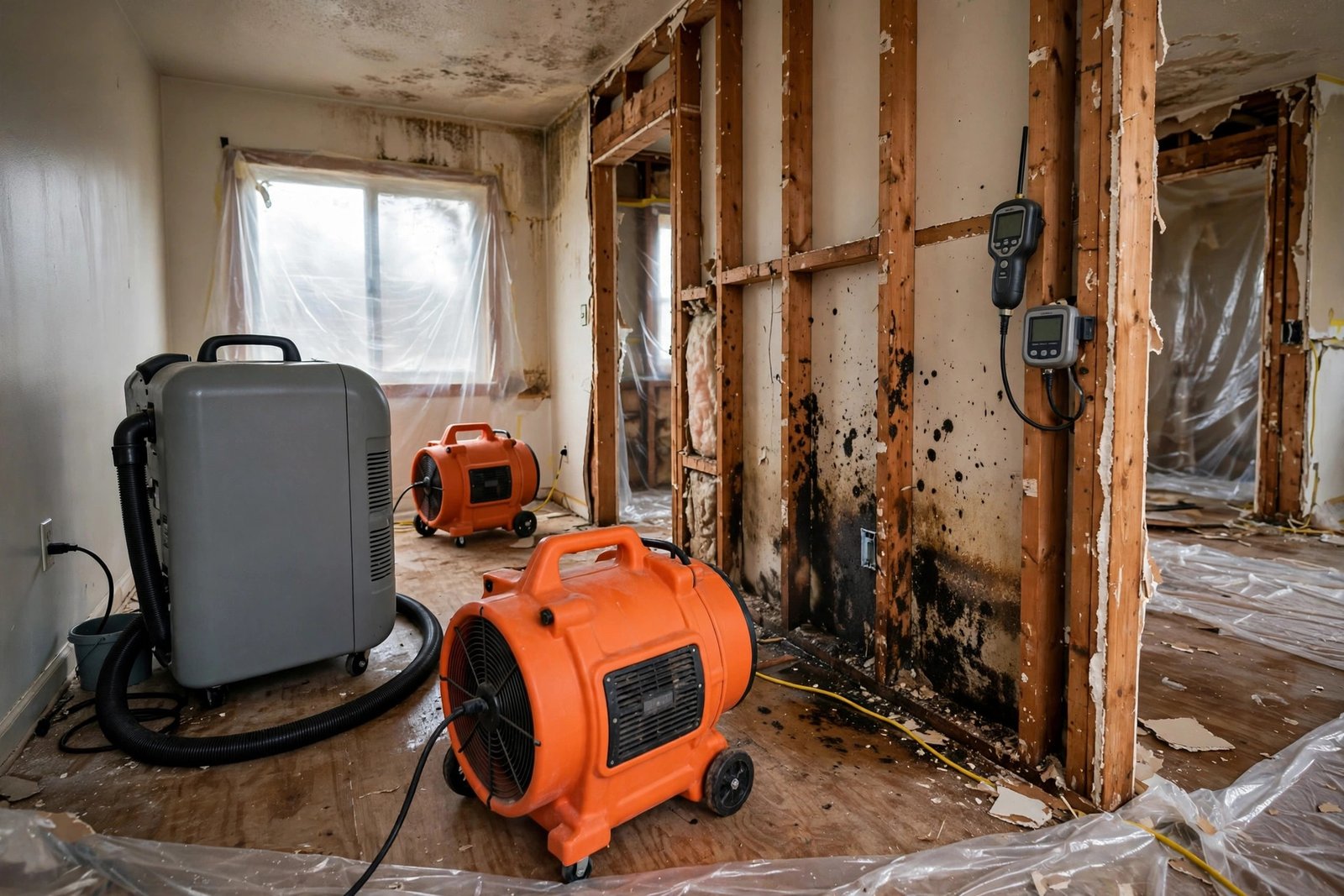
A proper drying setup is engineered, not improvised. Refrigerant dehumidifiers pull gallons of moisture from the air daily – sized to the cubic footage and saturation level of your space. Desiccant dehumidifiers handle cold or deeply saturated environments where refrigerants struggle. Air movers create high-velocity airflow across wet surfaces, accelerating evaporation. Floor drying mats pull moisture from hardwood without removal. And moisture meters – pin and pinless – verify progress daily against documented dry standards. When a company shows up with two box fans and a prayer, you’re not getting structural drying.
Every professional drying job follows this engineered setup – equipment sized to the space, progress verified daily with calibrated meters, and full documentation for your insurer.
Drying is the invisible half of every major job – from basement flood cleanup to whole-house floods. Columbia’s water damage restoration specialists verify every job with meter readings, not guesswork.
Structural Drying Timeline
| Step | Typical time |
|---|---|
| Assessment and full moisture mapping | 1-2 hrs |
| Drying chamber setup and equipment placement | 2-4 hrs |
| Active drying with daily moisture readings | 3-5 days |
| Final verification at dry standard | 4-8 hrs |
What Affects the Cost of Structural Drying
Drying cost scales with the cubic footage of the drying chamber, the saturation level, how many dehumidifiers and air movers the job requires, and how many days the equipment must run. Dense materials like hardwood, concrete, and plaster extend the timeline. The provider who takes your call confirms the scope, availability and price with you directly before any work begins.
Water Categories and Drying Protocol
Drying applies to every water category, but the protocol adapts: Category 1 jobs dry with standard chambers and equipment, Category 2 adds antimicrobial treatment, and Category 3 requires containment, protective equipment, and removal of contaminated porous materials before drying even begins. The drying science is the same – the safety protocol scales with the contamination.
Sources
Sources
- IICRC - The restoration industry's standards body (S500 water damage standard).
- U.S. EPA Mold - Mold growth timelines and cleanup guidance.
Frequently Asked Questions
How long does structural drying take?
Most residential jobs take 3 to 5 days of monitored drying. Dense materials like hardwood, concrete, and plaster, plus high saturation, can extend that timeline. The provider takes daily readings with calibrated moisture meters, and those readings, not guesswork, decide when it is done. Equipment stays until every material reaches its dry standard, so nothing is rushed.
Can I stay in the house during drying?
Usually yes, you can stay in your home while the provider dries it. The equipment is loud, because air movers run continuously, but the space remains livable for most families. The provider will tell you honestly if any area needs to stay clear for safety or for the drying to work properly. Most homeowners stay put.
Why not just let it air dry?
In Columbia’s humidity, air drying takes weeks, and the EPA’s 24-to-48-hour mold window does not wait for you. Materials left damp grow mold inside walls where you cannot see it until it is a major problem. Providers use sealed drying chambers, commercial air movers, and dehumidifiers to dry your home properly, so hidden moisture does not turn into mold.
How do you know when it's actually dry?
Providers use calibrated moisture meters compared against dry standards for each material, and log those readings daily. Feels dry is not a measurement, and no professional signs off on feelings. The readings are checked at marked points across every affected material, so you get proof that your home is truly dry before any repairs begin.
How much does professional structural drying cost?
It depends on the size of the area, the saturation level, the equipment count, and how many days drying runs. Dense materials and heavy saturation extend the job. No one can price a drying job accurately without seeing the space first. The provider who takes your call confirms the scope and price with you directly before work begins.
Can I rent dehumidifiers and dry it myself?
Consumer rentals move a fraction of the moisture commercial LGR and desiccant units do, and without calibrated moisture meters you cannot verify anything reached dry standard. Under-dried structure grows mold inside walls, where you will not see it until the problem is serious. The savings are not worth the risk when a provider can dry it properly and prove it.
Does the drying equipment run 24 hours a day?
Yes, it does. Air movers and dehumidifiers run continuously, with daily visits from the provider to take readings and reposition equipment. Turning equipment off at night lets moisture reabsorb and resets the clock, which stretches the job out and risks mold. Keeping everything running is how the home gets dry on schedule.
Will my insurance pay for the drying phase?
When drying follows a covered loss, insurers typically cover it. Adjusters approve drying claims backed by daily moisture logs and psychrometric readings, which providers produce as standard practice on every job. The provider documents the drying from start to finish, so your adjuster has the proof they need and your claim moves forward without unnecessary delays.
What does a professional structural drying service actually do?
A structural drying service removes the water trapped inside your building materials, not just the standing water on the floor. The provider maps moisture with thermal imaging and meters, creates a sealed drying chamber, places commercial air movers and dehumidifiers sized to the saturation level, and takes daily readings until every material returns to its documented dry standard.
Do you repair structural damage in Columbia, SC?
Yes. Structural damage in Columbia, SC from water intrusion is what the drying and repair process is built around. The provider maps the moisture, dries the framing and subfloors to verified readings, then repairs the damaged materials, including drywall, flooring, and trim. Everything is documented for your insurance claim, so call (803) 555-0147 to get connected.
Wet structure today is mold and rot tomorrow.
Wet structure today is mold and rot tomorrow. Call (803) 555-0147 for professional structural drying in Columbia, SC.